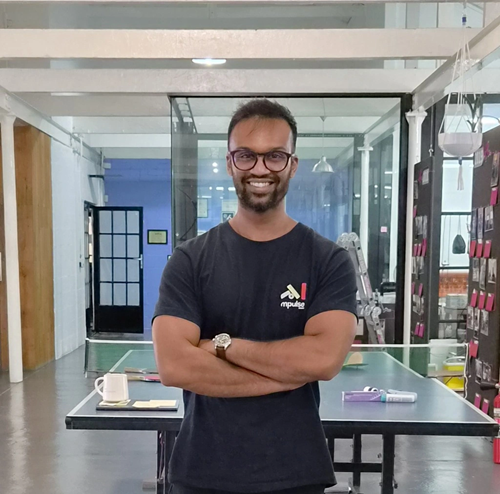
 Nelson Mandela University alumnus Moksham Soundarajan, who holds a BEng in Mechatronics, has successfully combined his expertise in engineering and technology with the field of medical science. As Senior Testing Engineer at Impulse Biomedical, he plays a pivotal role in bridging innovative medical technologies with the regulatory and compliance requirements that bring life-saving solutions to market.
In this Q&A, Soundarajan reflects on his career journey, sharing how he transitioned from pharmaceutical automation into the biomedical sector and leveraged his engineering background to develop technologies that have a direct impact on improving and saving lives.
1. Can you share more about your current role at Impulse Biomed and what your key responsibilities involve in developing medical technology solutions?
As a Senior Testing Engineer, my job is to make sure our medical devices like the ZiBiPen autoinjector are completely safe, reliable, and work perfectly every single time. I act as the bridge between the creative engineers who design the technology and the strict legal rules required to get medical products to patients.
My day-to-day focus involves:
Setting the Testing Blueprint: Writing the master plans and exact requirements for the specialized equipment we use to test our devices.
Testing for Worst-Case Scenarios: Designing intense stress tests to see how the materials and mechanical parts handle extreme conditions, ensuring they never fail when a patient needs them.
Meeting Global Standards: Ensuring every single test we run aligns perfectly with international medical safety laws, turning complex regulations into clear, proven data.
2. What inspired your transition into the biomedical engineering and regulated manufacturing space, and how has your journey evolved since your studies at Nelson Mandela University?
My engineering journey started with a BEng mechatronics degree at Nelson Mandela University, where I fell in love with complex, automated systems. Early on, I applied these skills to large-scale pharmaceutical automation. However, I soon realized I wanted to use my technical background to make a more direct, personal impact on people's lives.
Transitioning into biomedical engineering allowed me to do just that. Moving from massive production lines to precise medical devices shift my focus toward absolute safety and reliability. In this field, a fraction of a millimeter or a split second can save a life, and evolving my career to protect patient safety has been incredibly fulfilling.
3. You’ve worked across production, quality, and engineering projects — including vaccine manufacturing and automated inspection systems. Which experience has had the biggest impact on your professional growth?
While working on large-scale vaccine manufacturing was an incredible experience, working with automated production systems and the teams that operated the equipment had the biggest impact on my growth.
For example Automated inspection in the context of packaging systems is essentially teaching machines how to catch tiny defects at incredibly high speeds. In the medical world, the stakes are massive: a single missed error could harm a patient, but being too strict can slow down production. Learning how to balance absolute safety with smooth factory operations forced me to look at the big picture and taught me how to manage risk at the highest level.
4. How do you approach problem-solving in highly regulated environments where quality, compliance, and innovation must all work together?
I approach problem-solving by intentionally trying to find the weak points in a design before anyone else does. In medical tech, you can't just innovate freely; you have to innovate responsibly.
First, I look at the rules and regulations as fixed boundaries, not roadblocks. Next, I design tests that deliberately push a device to its absolute limits to see exactly where and how it might break. By understanding these failure points early on, we can design safety features right into the product from day one, rather than trying to fix compliance issues at the very end.
5. With your experience in Lean Six Sigma and process optimisation, what do you believe are the biggest opportunities for improving efficiency and innovation in the medical device industry today?
The biggest opportunity today is moving toward real-time, automated quality checks right on the production line.
Traditionally, the medical industry checks the quality of a product after a whole batch is already made. If something is wrong, you have to throw everything away, which wastes time and money. By using smart automation and data to check quality continuously as things are being built, we can spot mistakes instantly. This prevents waste, keeps things incredibly safe, and gets life-saving innovations to patients much faster.
6. What advice would you give to students and alumni in biomedical engineering looking to innovate and create impact in the medical technology field, especially within regulated environments?
My advice is to cultivate deep resilience and learn to thrive in the face of constant change. In the medical technology field, you will regularly encounter shifting regulations, unexpected technical roadblocks, and design challenges that initially feel completely impossible to solve.
Don't let rigid plans or sudden setbacks discourage you. Instead, look at massive constraints as a creative challenge. True impact in this industry comes down to your ability to stay calm under pressure, adapt your engineering strategy when the environment changes, and persistently break down complex, high-stakes problems until you find a reliable solution.
Soundarajan is proof that it is possible to advance your career into anything that you want, if you continue to strive for excellence by working hard, and figuring out what exactly you have to do to reach your desired goals.