“Maternal labour is often treated as background, rather than as a formative force in shaping political consciousness, values, and leadership”.
“In the case of Nelson Mandela, his mother’s influence is acknowledged but not deeply examined. My work addresses this gap by positioning maternal influence as central, rather than peripheral, to the making of history and democratic thought,” says Bongco.
Bongco’s academic focus is rooted in her upbringing in a family shaped by political activism during apartheid. Stories of resistance, including those of her forefathers such as Washington Bongco, sparked an early interest in both visible and hidden forms of influence.
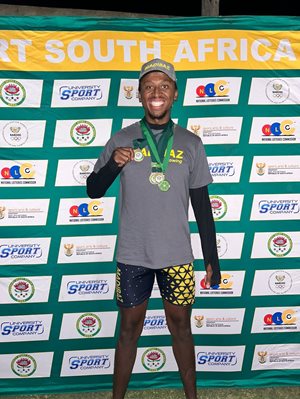 Siyabonga Mhlungu: Novice rower Siyabonga Mhlungu picked up three gold medals at the Ussa sprints regatta on the Misverstand Dam in the Western Cape.
Mhlungu joined the Madibaz Rowing Club last year saying he wanted to win gold medals and left no stroke unturned in getting himself ready for his quest.
His first port of call was signing up for Mandela University’s Learn-to-Swim programme.
With that obstacle overcome, he headed to the Misverstand Dam in the Western Cape in April along with his teammates to implement the rest of the plan.
There he and his colleagues rowed their way to three victories in the novice section across the scull, coxed four and mixed eight disciplines, with club chairman Adam Stead doing duty as cox in the latter.
He also picked up a silver in the highly-technical double scull race.
The team’s triumph in the eight event is particularly meaningful given the club’s ongoing investment in developing new rowers.
Numbers had in fact increased to such an extent that the team comprised 25 rowers, of which 16 were men and nine women.
Read more: Nelson Mandela University News
PhD graduate overcomes drug addiction to study effects of drugs on the brain
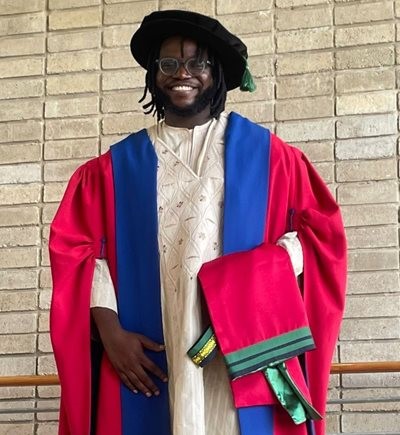
A Nelson Mandela doctoral student overcame drug addiction in his youth to graduate recently with a PhD on the neuroscience of the addictive brain.
Dr Musa Aminu, born in northern Nigeria, overcame substance use in his youth and decided to help others by pursuing an undergraduate degree in human physiology, to understand how the brain works; and a master’s in pharmacology and therapeutics to understand how drugs affect the brain.
His substance use problem started before he completed high school.
“What began as ‘fun and games’ with cigarettes and alcohol quickly became a habit. I started using cannabis, and thereafter felt more comfortable trying other drugs. I found myself struggling to stay in school at the age of 18,” he said.
At university he went from being an ‘A’ student to struggling to pass.
“My drug use became my number one priority. I needed money to purchase drugs. That became the root cause of my problems with my family. I found ways to get money from my mother for my drug use, until she could no longer trust me.”
Dr Aminu said he would even spend his tuition fees to purchase drugs.
“Eventually, my mental and physical health began to deteriorate. I dropped out of university and had a near-death experience due to drug use. That was when I knew I could no longer continue this path. I sought help, and my family checked me into a drug rehabilitation centre for four months.”
Read more: Nelson Mandela University News
Master’s student in Physics Hayley Britz selected to attend Heidelberg Laureate Forum
MSc in Physics student at Nelson Mandela University Hayley Britz has been selected to attend the 13th Heidelberg Laureate Forum (HLF) at Heidelberg University in Germany in September.
 Hayley Britz
The HLF is an annual weeklong networking conference for which 200 students in Mathematics and Computer Science disciplines are internationally selected to interact with recipients of the most esteemed awards in their fields (laureates). This presents an unparalleled opportunity to connect with and be mentored and encouraged by these recipients, says Hayley.
Hayley started her master’s studies at the University’s CHRTEM (Centre for High Resolution Transmission Electron Microscopy) this year.
Her research comprises using computer simulations to study how hydrogen atoms move through iron at the atomic level under mechanical strain.
This research helps improve the safety and reliability of materials used in clean and sustainable nuclear and hydrogen energy technologies, she says. Her supervisors are Professor Jaco Olivier, Dr Hlanganani Nyembe and Dr Genevéve Marx.
Read more: Nelson Mandela University News
Master’s graduate develops cost-effective hypertension drug
Hypertension or high blood pressure is a major problem on my maternal side, everyone suffers from this disease which is the underlying driver of heart disease and strokes, and the biggest killer worldwide.
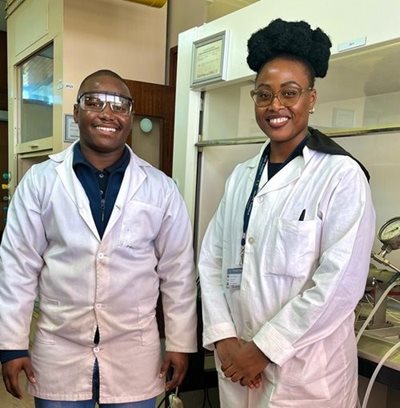 Siphosethu Kota, with fellow PhD candidate Clementine Moreku in the Flow Chemistry Lab
This was a significant motivator for my Master of Science in Chemistry for which I chose to develop a better, more cost-effective method to produce Enalapril, which lowers blood pressure, and is one of the most prescribed drugs in hypertension treatment, listed as a World Health Organisation (WHO) essential medicine.
My goal is to develop something with local and global impact, and I am committed to helping people with hypertension. It would also fill me with pride to be able to help my family and community. I have a phrase that resonates with communities of colour, which is “Umjita wase Kasi”. It directly translates to “A guy from the township”. I’m from Zwide in Gqeberha and I hope I can inspire other township learners to study hard and get a degree.
I graduated with my Master’s degree in April and I am now continuing with my doctorate. I’ve been at Nelson Mandela University since my BSc degree, followed by my Honours in the Department of Chemistry. For my Master’s I was accepted into the university’s South African Research Chair Initiative in Microfluidic Bio/Chemical Processing, headed by Professor Paul Watts who is my supervisor and a phenomenal scientist.