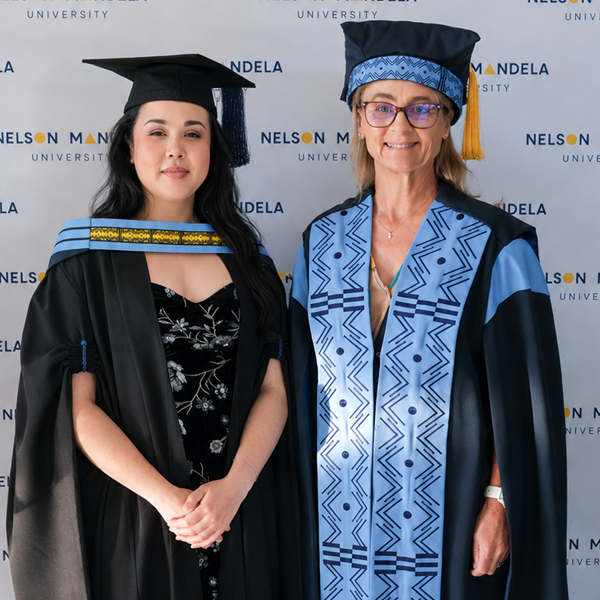
 Master's graduate Moi-Sui Ah Goo together with Executive Dean of Law Professor Lynn Biggs
“South Africa's rape laws are in urgent need of reform,” says Ah Goo whose ground-breaking Master’s research, Abolition of the Defence of Subjective Consent: Towards an Affirmative Consent Model for Rape, argues that the legal system should move away from a framework that focuses on what an accused person claims to have believed.
"The law should require more than a claimed belief that someone consented, it should demand a clear and unequivocal ‘yes’," explains Ah Goo who will be admitted as an advocate on 24 July.
A clear and unequivocal ‘yes’
At a time when the nation is searching for more effective responses to sexual and gender-based violence, Ah Goo's research is among the first Master's dissertations in South Africa to comprehensively examine the affirmative consent model (ACM) within the context of rape law.
Under the ACM model, consent is not assumed from silence or passivity, nor from previous sexual history, or a lack of physical resistance. Instead, consent must be actively sought and maintained throughout the sexual interaction through words or conduct that positively indicate agreement to engage in sexual activity. It needs to be clear, voluntary, conscious and ongoing.”
Read more: Nelson Mandela University News
Mandela University’s Prof Janine Adams one of 29 experts contributing to the Starfish Barometer 2026
Through her expertise in the protection and restoration of coastal ecosystems Nelson Mandela University’s Professor Janine Adams has contributed to the Starfish Barometer 2026.
 “The starfish barometer provides an overview of the ocean state, identifying where global actions are urgently needed” said Distinguished Professor Adams, the DSI-NRF South African Research Chair in Shallow Water Ecosystems at the University.
She also represents the Institute for Coastal and Marine Research and Department of Botany.
Drawing on the latest peer-reviewed science and international assessments, the report highlights accelerating ocean change, rising societal and economic impacts, and a widening gap between human pressures and protection efforts.
The Starfish Barometer 2026, an international scientific assessment of the relationship between the Ocean and Humanity, has been published earlier this month in State of the Planet.
First launched at the third United Nations Ocean Conference in 2025, the 2026 edition has grown into a global, multidisciplinary scientific effort, bringing together 29 experts from 14 countries across oceanography, climate science, ecology, economics and social sciences.