
The recent launch took place at the University’s Ocean Sciences Campus, where the Lab is also situated.
From left, Shoeshoe Qhu (MDDA CEO), Prof Pamela Maseko (Executive Dean) and Moipane Malefane, MDDA Board Member.
Conceptualised and developed by the Faculty of Humanities under the leadership of the Schools of Language, Media & Communication, and Visual and Performing Arts, the Lab was realised in partnership with the Media Development & Diversity Agency (MDDA) and the Economic Development Fund (EDF), with a contribution of more than R1,15 million.
The EDF, established in 2017 and administered by the MDDA, was created in response to findings by the Competition Tribunal, which highlighted persistent exclusionary practices and structural imbalances within South Africa’s media sector.
With this support, the Creative Media Lab responds to the growing need for graduates with practical industry experience by integrating real-world project work into the student learning experience.
Read more: Nelson Mandela University News
Graduation marks next step for media practitioners at Nelson Mandela University
On Friday, 10 April, the graduation stage at Nelson Mandela University brought together two familiar voices in the media space – Ayabonga Kekana and Mzwandile Ntshona, not as broadcasters, but as graduates of the Department of Media and Communication.
 Ayabonga Kekana and Mzwandile Ntshona
Already established as radio personalities and content creators with strong digital followings, the duo returned to formal study to deepen their craft.
Kekana completed his BA Honours in Media Studies, while Ntshona graduated with a Bachelor of Arts in Media, Communication and Culture (BA MCC).
Their shared milestone reflects a common approach to the industry: build your platform but continue to invest in knowledge.
While their work reaches different audiences, their journeys intersect in using media with intention and purpose, and in understanding its responsibility in society.
Ayabonga Kekana: Content with purpose
Known online as ‘Somlomo,’ isiXhosa for spokesperson, Kekana has built a following through humour that often carries deeper social commentary. His content, which unpacks modern masculinity and everyday realities, is shaped in part by his upbringing in a woman-led household.
Read more: Nelson Mandela University News
First PhD in Food, Nutrition and Wellness focuses on rising hunger and malnutrition among children
Household food insecurity in low-income Eastern Cape communities is extensive and worsening, marked by declining dietary diversity, rising hunger, as well as malnutrition in children.
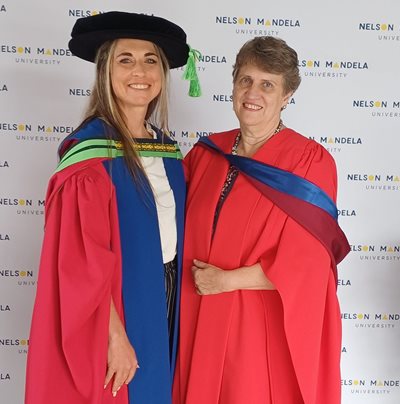 Dr Madeleine Nienaber and her supervisor Professor Annelie Gresse
“Despite global efforts to achieve Zero Hunger, food insecurity remains widespread in South Africa, especially in low-income communities where poverty, unemployment and shocks, such as the COVID-19 pandemic, increase vulnerability”, says Dr Madeleine Nienaber.
These are among the conclusions of Dr Nienaber’s doctoral research, the first PhD in Food, Nutrition and Wellness, based in the Nelson Mandela University’s Department of Human Nutrition and Dietetics.
Her supervisor was Professor Annelie Gresse, who started this Department at Mandela University.
As co-supervisor, Emeritus Professor Rosa du Randt, also provided also valuable inputs into the research process, as well as the international co-supervisor, Dr Christin Lang from the University of Basel, Switserland, who ensured a global perspective.
Existing measurement tools often fail to capture the multidimensional nature and context of food insecurity. Dr Nienaber’s research recommends surveillance and implementing targeted, context-specific, locally relevant interventions as being essential to improve food security and resilience to socioeconomic shocks.
Read more: Nelson Mandela University News
Brigadier General Christopher Mbaakanyi awarded PhD in Conflict Studies
An insatiable quest for intellectual growth and a deep commitment to driving meaningful change in conflict, peace, security and violence studies saw a decorated soldier cross the Nelson Mandela University graduation stage not in military gear, but academic regalia after obtaining a doctoral degree in Conflict Transformation and Management.
 Brigadier General Christopher Mbaakanyi, right, together with his supervisor Professor Ntsikelelo Breakfast
The Motswana military leader brings a wealth of experience to his academic achievement, including participation in United Nations peacekeeping missions, a background in telecommunications and radar engineering, and three master’s degrees in project management (2016), strategic management (2020), and conflict transformation and management (2020).
Bridging theory and practice, his doctoral research was shaped by his deployment in South Sudan, inspiring a systems-based analysis of Botswana’s fragmented and overlapping anti-poverty strategies, policies and programmes.
“Witnessing the realities of conflict and deprivation first-hand shaped my desire to pursue research in rural development and human security, with the aim of contributing to practical structural violence solutions,” he says.
Read more: Nelson Mandela University News
 Dr Andile Mhlahlo, an academic literacies practitioner at the Academic Literacies Writing Programme at Mandela University, has struggled with chronic pain in his limbs for years.
This is an invisible condition that has affected his ability to work.
“Obtaining my PhD was not easy because of a unique medical condition that I am experiencing. I have suffered chronic pain in my limbs for many years, and the medical practitioners have not been able to help me.”
Referring to his pain, he said, “sometimes, it feels like a sharp pain, and at other times it becomes a burning sensation”.
The pain has affected his ability to participate in daily activities like running, walking fast, holding something tight, lifting heavy items, handwriting and typing on a computer, which was a challenge while he pursued his doctorate.
“Typing on a laptop triggers pain, hence I am using voice recognition software to type.” It took more than a month to train his laptop to recognise his voice. “If my laptop has a software or hardware problem, my writing process had to stop until the problem is resolved. This contributed to delays in submitting my thesis.”
Dr Mhlahlo explained that voice recognition was ineffective when writing people’s names, including his academic reference list, so he sought the help of student assistants.
Read more: Nelson Mandela University News
Student defies odds to graduate and inspire future learners

When Daniel Freeman, 25, crossed the graduation stage to receive his BEd Foundation Phase qualification, he did so, celebrating the gift of life and the lives he has yet to impact.
Daniel Freeman together with his parents
In the second year of his education studies, while competing in a Judo competition, Daniel was seriously injured when his opponent landed an illegal blow to Daniel’s head.
Rushed to the hospital, with the symptoms of a concussion, doctors discovered that Daniel’s injuries were more extensive than a mere concussion. They found that he had also sustained injury to his kidneys, which led to kidney failure, requiring dialysis.
“The doctors prepared my parents for the worst, believing that I would not survive, the days that followed,” he said.
For the next two weeks, surrounded by the prayers of his anxious parents and loved ones, Daniel fought for his life, in that hospital bed.
Read more: Nelson Mandela University News